
Bookmark this page for quick reference
The first week back to school is when most morning routines either take shape or fall apart entirely.
Having a working checklist before the school year starts, not after, is what makes the difference between a repeatable system and a daily scramble.
What This List Is For:
This checklist covers the parent side of a school morning routine: what needs to happen before the kids wake up, what tasks get handed off to children by age, and what the household needs in place each morning for a consistent on-time departure.
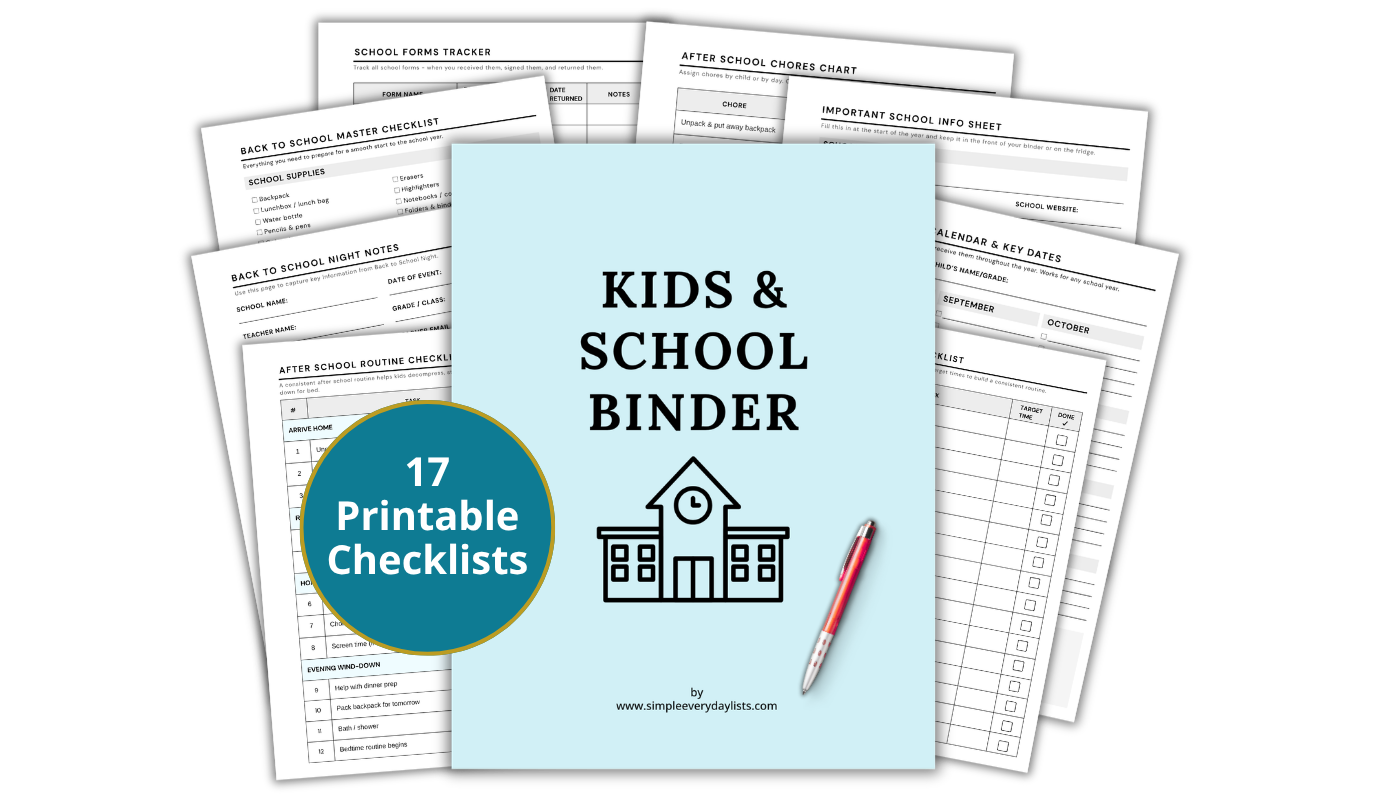
📄 A formatted, print-ready version of this list is included in the Kids & School Binder.
Keeping school-related lists in one place makes it easier to find what you need and reuse the same checklists each year without starting from scratch.
This includes preparation lists, routine trackers, forms checklists, and event lists that come around on a predictable schedule. For a full overview of what’s covered, visit our school checklists for parents guide.
Below are the details typically included in a back-to-school morning routine checklist.
What to Include in a Back-to-School Morning Routine Checklist
The most reliable morning routines run on prep that happens the night before, a clear sequence for the morning itself, and a short departure check before anyone leaves the house.
Breaking the checklist into these three phases keeps it manageable and easy to hand off to kids as they’re ready for more independence.
The Night Before
The evening is where most morning friction gets eliminated.
These tasks take 15–20 minutes and prevent the common morning bottlenecks – missing shoes, unsigned forms, and no lunch packed.
- Backpack packed and placed by the door
- Homework and any school forms signed and inside the backpack
- Lunch packed or lunch money confirmed
- Outfit selected and laid out (including shoes and any sports gear or instruments needed)
- Water bottle filled and in the bag
- Wake-up time confirmed and alarm set
- Any next-day notes or reminders checked (permission slips, early dismissal, special events)
Getting through this list before bed means the morning starts with everything already in place rather than being assembled under time pressure.
Morning Sequence
The morning checklist works best when it runs in the same order each day.
Post this where kids can reference it independently – on the fridge, inside a locker, or in their binder.
Want a Ready-Made Version?
The Kids & School Binder consists of 17 checklists and trackers to help you plan, manage and organize the whole school year.
Learn more about the binder...- Wake up at a set time
- Bathroom: teeth, face, hair
- Get dressed (outfit already laid out)
- Eat breakfast
- Return backpack items to bag if anything was removed the night before
- Put on shoes and jacket
- Check lunch is packed
- Any final items added to the bag (phone, retainer, glasses)
A consistent order matters more than a perfect one – kids follow a predictable sequence faster than a flexible one.
Departure Check
A short checklist at the door prevents the most common last-minute issues.
Keep this to 5 items or fewer so it gets used consistently.
- Backpack
- Lunch or lunch money
- Phone or device (if applicable)
- Keys or bus pass
- Any items specific to that day (library book, gym clothes, instrument)
Running through this list at the door takes under a minute and catches the items most likely to get left behind.
Adjusting the Checklist by Age
A morning routine checklist looks different depending on the age of the child. The parent role shifts from doing most tasks to supervising and then to prompting.
For younger children in kindergarten through early elementary, the checklist is parent-led. The child follows along, but most tasks are completed with adult involvement. The parent moves through the list with them.
For mid-elementary through middle school, the checklist gets handed to the child. The parents’ role shifts to a final check at the door rather than task-by-task involvement.
Kids at this stage can manage the morning sequence independently with a posted checklist as a reference.
- K–2: Parent-led with child participation
- Grades 3–5: Child-led with parent available for questions
- Middle school: Fully child-managed; parent does departure check only
- High school: Student manages entire routine independently; routine may include earlier wake times for extracurriculars or longer commutes
Adjusting the checklist as kids get older keeps it practical and avoids the routine breaking down because it no longer matches what the child is actually capable of managing.
What to Add for the First Week Back
The first week of school has extra variables that a standard morning checklist doesn’t account for.
Add a temporary section to the checklist for back-to-school week that covers:
- School supply list confirmed as packed
- New teacher or classroom location noted
- Drop-off or bus stop confirmed for the new year
- Any first-day paperwork or emergency forms in the backpack
- Photo taken (if that’s part of your family’s routine)
- Arrival time confirmed – some schools shift schedules year to year
This section gets removed after the first week, and the checklist returns to its standard format.
Having it written down rather than held in memory means nothing gets missed during a week that already has more variables than usual.
Practical Notes
The morning routine checklist is set up once at the start of the school year and reviewed at semester breaks or when something consistently isn’t working.
Most families find they need to adjust it once, around week three, when the initial effort wears off, and then it holds for the rest of the year.
Keep two versions if you have children at different schools or different grade levels with different departure times. The structure stays the same; the timing and task-handoff level change.
Print the checklist and post it somewhere visible rather than keeping it digital. Kids of all ages follow a posted visual checklist more reliably than a phone-based reminder.
Final Notes
A school morning checklist is not complicated to build, but it does need to be specific enough to actually follow, because generic reminders don’t stick.
A checklist built around your household’s actual departure time, your kids’ ages, and your specific weekly variables will get used – one that’s vague won’t.
If you’d prefer a ready-made version, the printable Kids & School Binder includes a formatted version of this page, organized and ready to print.
Ready to set up the full system?
The Kids & School Binder includes 17 formatted, print-ready checklists covering the whole of the school year - organized and ready to use.
Learn more about the Kids & School Binder