
Bookmark this page for quick reference
If you want to plan your week without relying on one long, messy to-do list, a simple weekly planning list makes it easier to see what actually needs attention.
In fact, weekly planning works best when it’s simple, repeatable, and mostly the same every week.
What This List Is For:
A good weekly planning system usually isn’t one list; it’s a small set of lists that you review and reuse, week after week.
📄 Printable versions of these lists are available here.
The goal isn’t to plan perfectly; it’s to get everything out of your head and onto paper so the week feels more organised by default.
Some people keep them in a planner, some on loose paper, some in a notes app; the format doesn’t matter much; the structure does.
You might want to create your weekly lists on the weekend when you have more time – Sunday?
Below is a practical collection of weekly planning lists you can mix and match.
You don’t need all of them, as most people end up using three to five consistently.
The Master Weekly Overview List
This is the anchor list for the week; everything else tends to feed into it.
What it’s for:
To capture the full shape of the week at a glance before you get into details.
Typical items to include:
- Key appointments and fixed commitments
- Deadlines already set
- Time-bound tasks (calls, meetings, deliveries)
- Non-negotiables (school runs, care duties, work shifts)
This list is usually reviewed once at the start of the week and updated lightly if plans change.
Weekly To-Do List
This is the most familiar weekly list, and also the one most likely to get overloaded.
What it’s for:
To hold tasks that need to happen this week, but are not tied to a specific day yet.
Helpful categories inside the list:
Want a Ready-Made Version?
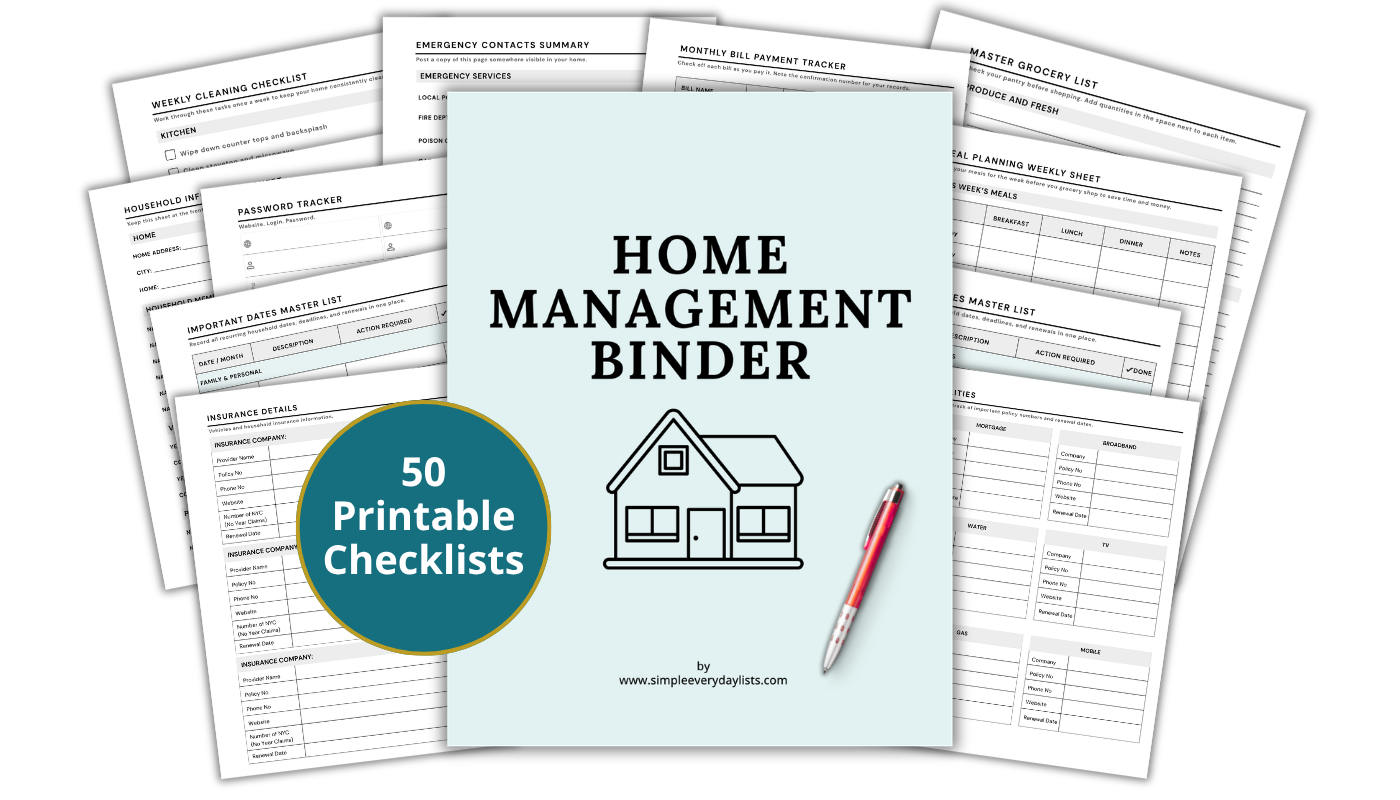
The Home Management Binder is a 50-page printable system covering every area of your household — bills, contacts, seasonal tasks, and more. Print once, use for years.
Learn more about the binder...- Work tasks
- Home tasks
- Admin & errands
- Short tasks (10–15 minutes)
Keeping this list separate from daily to-do lists helps prevent rewriting the same tasks every morning.
Daily Focus Lists (Monday–Sunday)
Instead of one long daily to-do list, many people prefer a short daily focus list for each day.
What it’s for:
To decide what actually matters today without dragging the whole week along with it.
Typical structure:
- Top 3 priorities
- Secondary tasks (if time allows)
- One “quick win” task
These lists are often created the night before or first thing in the morning using the weekly to-do list as the source.
Appointments & Time-Blocking List
This list supports calendar planning without replacing it.
What it’s for:
To see where your time is already spoken for before adding more tasks.
Items commonly included:
- Appointments not yet added to a digital calendar
- Rough time blocks for focused work
- Travel or prep time
- Buffer space
Some people rewrite this list midweek to rebalance time if plans shift.
Weekly Meals & Food Prep List
Food planning is one of the highest-impact weekly lists for reducing daily decisions.
What it’s for:
To plan meals once, instead of deciding three times a day.
Typical sections:
- Dinners by day
- Lunch ideas
- Breakfast basics
- Prep tasks (chopping, batch cooking)
This list usually connects directly to the weekly grocery list.
Weekly Grocery List
A weekly grocery list works best when it’s built from other lists, not from memory.
What it’s for:
To capture everything needed for the week in one place.
Common breakdown:
- Produce
- Pantry
- Fridge/freezer
- Household basics
Some people keep this list running all week and shop once; others update it before multiple smaller shops.
Home Reset List
This list focuses on maintaining the household at a baseline level.
What it’s for:
To spread household upkeep across the week instead of doing everything at once.
Items often included:
- Laundry cycles
- Kitchen reset
- Bathroom quick clean
- Floors / bins / recycling
This list is usually reused weekly with minor adjustments.
Even if you already have a task manager, a weekly work list helps with prioritisation.
What it’s for:
To decide what work actually needs attention this week.
Helpful sections:
- Must-do tasks
- Ongoing projects
- Tasks to delegate or defer
- Follow-ups
This list is often reviewed at the start and end of the work week.
Admin & Life Tasks List
These are the tasks that tend to get postponed because they’re not urgent, until they are.
What it’s for:
To give life admin a regular place in the week.
Examples:
- Emails to send
- Forms to complete
- Bills to check
- Appointments to book
Some people assign one specific day each week to work through this list.
Errands List
Keeping errands separate helps you batch them, so you can group tasks by location or route and get them done in one trip instead of spreading them across the week.
What it’s for:
To avoid multiple trips and forgotten stops.
Typical items:
- In-person errands
- Returns
- Pick-ups
- Drop-offs
This list often pairs well with a “leaving the house” checklist.
Waiting-On List
This is one of the most underrated weekly planning lists, because it quietly prevents tasks from stalling without adding anything new to your workload.
What it’s for:
To track things that can’t move forward until someone else responds.
Examples:
- Emails awaiting replies
- Orders pending delivery
- Forms submitted
- Calls returned
Reviewing this once a week prevents things from quietly stalling.
Weekly Review & Carry-Over List
This list closes the week and sets up the next one by creating a clear handover between what’s finished, what still matters, and what can be let go and sets up the next one.
What it’s for:
To decide what carries forward and what doesn’t.
Common items:
- Unfinished tasks to move
- Tasks to drop
- Notes for next week
- Early planning ideas
This list usually lives at the end of the week, often alongside the next week’s master overview.
Optional Lists Some People Add
Not everyone needs these, but they’re useful in certain seasons:
- Exercise or movement list
- Social plans list
- School or family logistics list
- Creative or personal projects list
- Spending check-in list
Only add lists that genuinely reduce thinking, as more lists aren’t automatically better.
How These Lists Work Together
Most weekly planning systems follow a simple flow:
- Review the Weekly Overview
- Build or update the Weekly To-Do List
- Assign priorities to Daily Focus Lists
- Check time using the Appointments List
- Close the week with a Review & Carry-Over List
Once set up, the same structure can be reused indefinitely.
Related Reading: How Daily, Weekly & Monthly Lists Work together
A Simple Weekly Planning Setup
If you want a minimal starting point, use just these five:
- Weekly Overview List
- Weekly To-Do List
- Daily Focus Lists
- Grocery List
- Weekly Review List
You can always add more later if needed.
Weekly planning lists work best when they’re boring, predictable, and easy to reuse.
If a list makes the week feel lighter or clearer, keep it. If it turns into extra work, it probably doesn’t belong in your system.
The right weekly planning setup is the one that quietly supports the week, without asking much in return.
You could go one step further and map out a monthly planning list, then transfer the tasks into weekly planning lists.
Whatever suits you and makes you feel the most comfortable doing!
Ready to set up the full system?
The Home Management Binder includes 50 formatted, print-ready checklists covering household finances, contacts, seasonal tasks, and everything in between - organized and ready to use.
Learn more about the Home Management Binder