

Bookmark this page for quick reference
Most households accumulate paperwork steadily: statements, policies, records, receipts, etc., and normally without a consistent system for where any of it goes.
A clear set of home filing categories solves that problem permanently, whether you’re using a filing cabinet, a file box, or a binder.
What This List Is For:
This is a reference list of home filing system categories for household paperwork. It covers the main document types most households need to keep, organized into broad categories so you can set up or reset a filing system without starting from scratch.
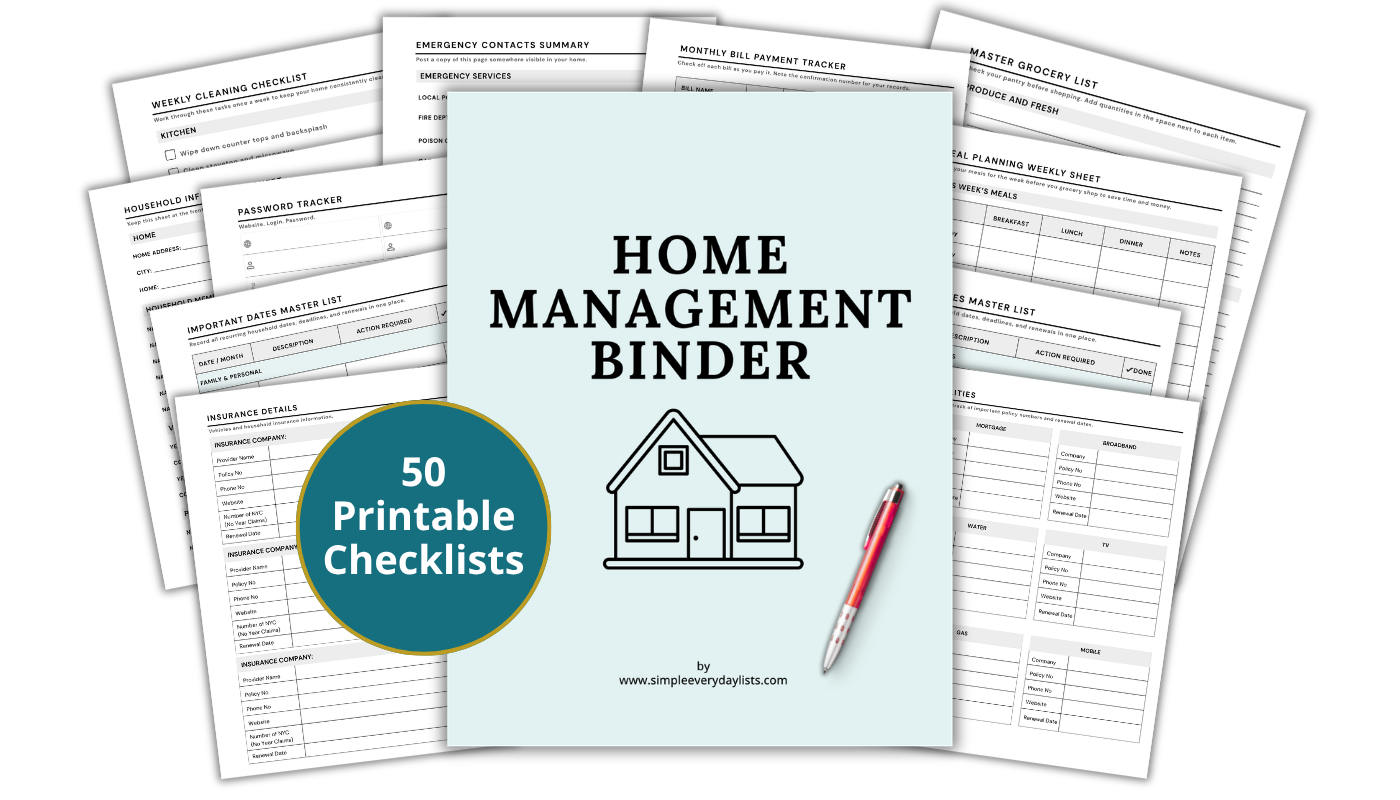
📄 The Home Management Binder includes formatted reference pages organized by category and ready to print.
What Is A Household Binder?
A household binder is a single reference point for the lists and information you use repeatedly to manage your home. For a full overview of how the system works, visit our household binder guide.
This post covers the standard categories for a home filing system across six main areas:
- Financial records
- Tax documents
- Insurance
- Medical
- Property & vehicle, and
- Legal & identity
Each section includes the specific document types that belong in that category and notes on what to keep versus what can eventually be discarded.
How to Structure Your Home Filing Categories
The most functional approach to categories for a home filing system is to keep the top-level structure broad and let the subfolders handle the details.
Six to eight main categories are the right range for most households, as that’s enough to keep things separated without creating a system so granular that filing becomes a project in itself.
Within each main category, use labeled subfolders or interior folders for specific document types.
For a home filing cabinet, hanging folders work well as the main categories, with manila or colored interior folders for subcategories.
For a file box or binder, use tabbed dividers for the main categories.
The categories below represent the standard structure for most households.
Simply add or remove sections based on what your household actually generates.
Financial Records
Financial documents are the largest category in most home filing systems and the one most worth getting right.
The general rule is one year for most day-to-day financial records, with longer retention for anything that supports a tax return or involves a major asset.
Want a Ready-Made Version?
The Home Management Binder is a 50-page printable system covering every area of your household — bills, contacts, seasonal tasks, and more. Print once, use for years.
Learn more about the binder...Documents to file under financial records:
- Bank statements: current and prior year
- Credit card statements: current year
- Pay stubs: current year, until reconciled against W-2
- Investment and brokerage statements: annual summaries for 7 years
- Loan documents: keep for the life of the loan
- Retirement account statements: annual summaries
- Records of major purchases: keep for as long as you own the item
Tax Documents
Tax records warrant their own category in any home filing cabinet system.
The IRS standard audit window drives most retention decisions here, and keeping tax documents separate from general financial records makes annual filing significantly easier.
Documents to file under tax records:
- Filed federal and state tax returns: 7 years
- W-2s and 1099s: 7 years
- Supporting documentation for deductions: 7 years
- Charitable donation receipts: 7 years
- Records of home improvements relevant to capital gains: for as long as you own the home, plus 7 years after sale
- Business-related home expense records, if applicable: 7 years
Insurance
Insurance documents should be split into two types:
- Active policies that need to be accessible, and
- Claim records that need to be retained for a set period.
Keeping these together in one home filing category makes it straightforward to locate a policy number or claims history quickly.
Documents to file under insurance:
- Home insurance: current policy and declarations page
- Auto insurance: current policy and declarations page
- Life insurance policies: permanent
- Health insurance: current policy and explanation of benefits statements
- Umbrella or additional liability policies
- Open or recent claims documentation: keep for 7 years after settlement
- Expired policies: 3 years if any possibility of a late claim remains
Medical Records
Medical filing categories are worth maintaining as a household record, even when providers keep their own records.
Having key documents on hand matters during emergencies, when switching providers, or when schools or employers request documentation.
Documents to file under medical records:
- Vaccination records: permanently
- Major diagnoses and surgical records: permanently
- Discharge summaries: permanently
- Prescription records: 1 year, longer for ongoing conditions
- Medical bills: 1 year after payment, or 7 years if tax-deductible
- Explanation of benefits statements: 1 year after resolution
- Children’s health records: until adulthood, then transfer to them
- Dental and vision records: 1 to 3 years
Property and Vehicle
Property documents should be kept for as long as you own the asset, with a retention period afterward that covers any tax implications or disputes.
These home filing cabinet categories are among the most important to keep organized and accessible.
Documents to file under property:
- Property deed: permanently, for as long as you own the home
- Mortgage documents and closing paperwork: life of the loan plus 7 years
- Home improvement receipts and permits: for as long as you own the home
- HOA documents: for as long as you own the property
- Lease agreements: duration of lease plus 3 years after it ends
- Appliance manuals and warranties: for as long as you own the item
- Home inspection reports: permanently
Documents to file under vehicles:
- Vehicle title: permanently, until the vehicle is sold
- Vehicle purchase and sale records: 7 years
- Auto loan documents: life of the loan
- Registration: current year
- Service and repair records: for as long as you own the vehicle
Legal and Identity Documents
Legal and identity documents are the permanent category in any home filing system.
These should be kept in a fireproof location at home or duplicated in secure digital storage.
This is the category where a home filing cabinet with a locking drawer is most useful.
Documents to file under legal and identity:
- Birth certificates: permanently
- Social Security cards: permanently
- Passports: keep expired passports for at least 5 years
- Marriage and divorce certificates: permanently
- Adoption records: permanently
- Death certificates for family members: permanently
- Wills and trusts: permanently; update when amended
- Power of attorney documents: permanently
- Military service records: permanently
- Citizenship documents: permanently
Practical Notes
The most common mistake in setting up home filing categories is creating too many of them.
A system with 20 narrow categories gets abandoned quickly because filing becomes a decision every time.
Start with the six broad categories above and only add subcategories where you genuinely have enough volume to warrant them; tax documents, for example, often benefit from a subfolder per year.
Review the filing system once a year, ideally after tax season when you’re already handling paperwork.
Pull anything that has passed its retention window and shred anything with personal or financial information using a cross-cut shredder.
If your household stores statements and records electronically, use the same category structure for your digital filing system.
Consistent home filing categories across both paper and digital records make retrieval straightforward regardless of where a document lives.
Some households keep two separate physical systems:
- An active file for documents referenced regularly, and
- A long-term archive for records kept for compliance or legal reasons.
If that split works better for your household, use the categories above for both; this way, the structure stays consistent even if the storage locations differ.
Closing
A well-structured set of home filing system categories is a one-time setup that pays off every time you need to locate a document quickly.
The categories above cover what most households need across financial, tax, insurance, medical, property, and legal records; and they work whether you’re filing in a cabinet, a box, or a binder.
If you would like one structured place for all of your household records, the Home Management Binder collects every log, checklist, and record page into a single printable binder you can personalize to your own needs.
Ready to set up the full system?
The Home Management Binder includes 50 formatted, print-ready checklists covering household finances, contacts, seasonal tasks, and everything in between - organized and ready to use.
Learn more about the Home Management Binder