
Bookmark this page for quick reference
An estate planning documents checklist gives every household a clear reference for the legal, financial, and personal paperwork that needs to be located, organized, and accessible.
These documents cover everything from wills and trusts to insurance policies and account records.
What This List Is For:
This checklist helps you identify, gather, and organize the estate planning documents your household should have on file.
📄 You can find a blank Estate Planning Documents printable inside the Home Management Binder.
Many households keep this sheet at the front of their home management binder so the most important details are easy to find when needed.
What Is A Household Binder?
A household binder is a single reference point for the lists and information you use repeatedly to manage your home. For a full overview of how the system works, visit our household binder guide.
Below are the details typically included in this type of planning document list.
Information to Include in an Estate Planning Documents Checklist
Last Will and Testament
A last will and testament is one of the foundational estate planning documents every adult should have on file.
It records how assets are to be distributed and who is designated to carry out those instructions.
A copy should be stored somewhere accessible, with the original held by an attorney or in a secure location.
- Full legal name of the testator
- Date the will was signed and executed
- Name and contact information of the executing attorney
- Location of the original document
- Name of the executor
- Date of the most recent update or amendment
- Names of witnesses listed on the document
Tracking the document location and last-updated date keeps this section accurate over time.
Living Trust Documents
A revocable living trust is used to manage and transfer assets outside of the probate process.
This section records the trust details so the trustee and successor trustee can be identified quickly.
Not all households will have a trust, but for those that do, this information is important to keep current.
- Trust name and date of establishment
- Name of the grantor
- Name of the current trustee
- Name of the successor trustee
- Assets held within the trust
- Location of the original trust document
- Name of the attorney who drafted the trust
Recording this information in one place ensures the right people can be contacted when needed.
Power of Attorney
A durable power of attorney designates someone to manage financial decisions if an individual becomes incapacitated.
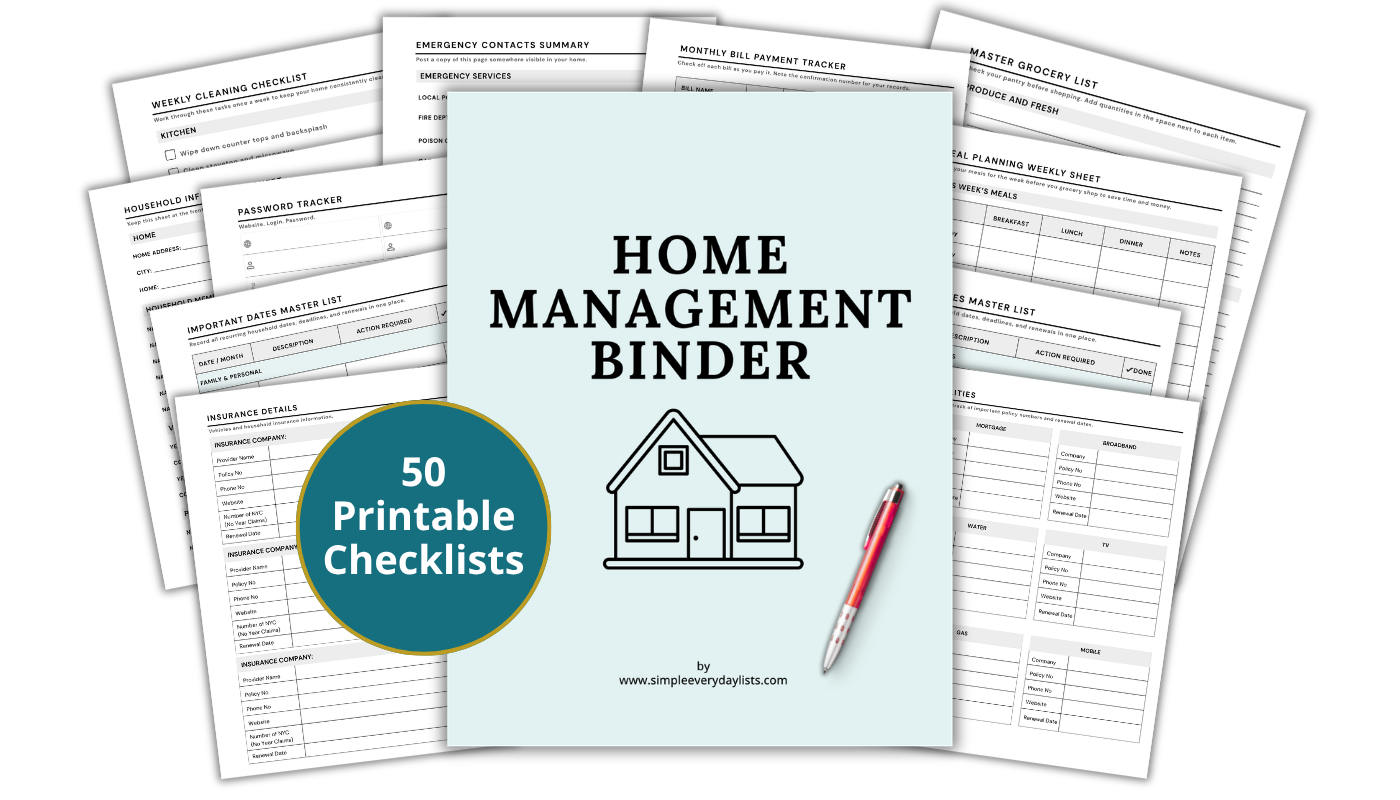
Want a Ready-Made Version?
The Home Management Binder is a 50-page printable system covering every area of your household — bills, contacts, seasonal tasks, and more. Print once, use for years.
Learn more about the binder...This document is time-sensitive and must be accessible when needed. Households may have both a general and a financial power of attorney on file.
- Full name of the principal
- Name and contact information of the agent
- Type of power of attorney (general, durable, limited)
- Effective date and any expiration terms
- Document location
- Name of the notary or attorney who executed it
- Date of last review
Keeping agent contact details current reduces delays if the document ever needs to be acted on.
Healthcare Directive and Living Will
A healthcare directive, sometimes called a living will or advance directive, records medical preferences if someone is unable to speak for themselves.
This document is often used alongside a healthcare proxy or medical power of attorney.
Both documents should be stored where they can be retrieved quickly.
- Full name of the individual
- Name of the healthcare proxy or agent
- Agent contact information
- Type of directive on file (living will, advance directive)
- Document location
- Name of the healthcare provider or facility holding a copy
- Date of most recent update
Medical facilities may need this document without advance notice, so the storage location should be clearly noted.
Life Insurance Policies
Life insurance policy details should be recorded as part of any estate planning documents checklist so beneficiaries can locate and file claims efficiently.
This section covers each active policy held by members of the household. It is also worth noting any employer-provided life insurance coverage.
- Insurance company name and contact number
- Policy number
- Coverage amount
- Primary and contingent beneficiary names
- Annual premium and payment schedule
- Policy document location
- Agent name and contact information
This section pairs well with a household insurance tracker if additional property or health policies are also being organized.
Retirement Account Records
Retirement accounts such as 401(k) plans, IRAs, and pension plans transfer to beneficiaries outside of the will, which makes it important to record this information separately.
This section helps ensure beneficiary designations are up to date and accessible. Account information should be reviewed following any major life event.
- Account type (401k, IRA, Roth IRA, pension)
- Financial institution name
- Account number
- Primary beneficiary name
- Contingent beneficiary name
- Contact number for the plan administrator
- Date beneficiary designations were last updated
Beneficiary designations on retirement accounts take legal precedence over the will, so keeping this section current is important.
Bank and Investment Account Information
A record of bank and investment accounts makes it possible for an executor or family member to identify and access household accounts when needed.
This section covers checking, savings, and brokerage accounts. It does not need to include passwords, but should capture enough identifying detail to locate each account.
- Financial institution name
- Account type (checking, savings, brokerage)
- Account number
- Held jointly or individually
- Transfer-on-death (TOD) beneficiary name if designated
- Customer service phone number
- Approximate account balance range for reference
This section is often used alongside a home finance records list when tracking the full scope of household accounts.
Real Estate and Property Documents
Property documents are a key part of estate administration and should be listed even if the originals are held at a title company or attorney’s office.
This section covers owned real estate, including a primary residence, vacation property, or land holdings – mortgage information is also recorded here.
This section covers owned real estate, including a primary residence, vacation property, or land holdings. Mortgage information is also recorded here.
- Property address
- Name of current titleholder(s)
- Deed type and location of deed
- Mortgage lender name and account number
- Mortgage servicer contact information
- Property tax account number
- Date of most recent appraisal
Property held in a trust should cross-reference the trust documents recorded in the living trust section.
Vehicle Titles and Ownership Records
Vehicle titles establish legal ownership and are needed for transfer during estate administration.
This section records each vehicle owned by the household.
Paid-off vehicles should have the title held at home or in a secure storage location.
- Vehicle year, make, and model
- Vehicle Identification Number (VIN)
- Name on title
- Title location
- Lienholder name if applicable
- State of registration
- License plate number
Keeping a note of the title location avoids searching at the time of transfer.
Digital Assets and Online Accounts
Digital assets include email accounts, online financial platforms, and subscription services that may need to be accessed or closed after death.
This list provides a reference list of accounts rather than storing actual login credentials.
A separate secure document or password manager should hold credential details.
- Account type and platform name
- Email address associated with the account
- Whether a digital asset clause is included in the will
- Name of platform’s legacy contact or beneficiary if designated
- Instructions for account closure or transfer
- Location of secure credential document
- Date the list was last reviewed
A brief review of this section once a year helps ensure all active accounts are captured.
Personal Identity and Legal Records
Personal identity documents are frequently needed during estate administration and should be located before they are required.
This section records where key documents are stored rather than duplicating sensitive originals.
Social Security records, birth certificates, and marriage certificates fall into this category.
- Birth certificate location
- Social Security card location
- Passport number and expiration date
- Marriage certificate location
- Divorce decree location if applicable
- Military discharge papers (DD-214) location if applicable
- Naturalization certificate location if applicable
Noting the storage location for each document is more useful than attempting to keep all originals in one place.
Funeral Preferences and Final Arrangements
A record of funeral preferences reduces the decisions family members must make under time pressure.
This section documents any pre-arranged or prepaid funeral plans and records general preferences if no formal plan exists.
Some households include a letter of instruction alongside the will to cover this information in more detail.
- Funeral home name and contact information if pre-arranged
- Prepaid funeral plan number if applicable
- Burial or cremation preference
- Cemetery or final resting location
- Religious or cultural preferences for the service
- Contact for officiant or celebrant if designated
- Location of any written letter of instruction
Keeping this information current ensures those handling final arrangements have clear direction.
Using Your Estate Planning Documents Checklist
An estate planning documents checklist works best as a living reference that is reviewed and updated after major life events such as marriage, the birth of a child, a home purchase, or retirement.
The goal is not to store every original document in one location, but to record where each document can be found and who holds the relevant information.
Therefore, this list reduces the burden on family members and gives an executor a clear starting point.
Many of the sections here connect to other lists in a broader household records system.
Retirement account details align with a household financial records list, and insurance policies cross-reference a home insurance tracker.
Building these connections makes the overall system more useful over time.
If you’re working on organizing your household records, a household binder brings together the key reference lists and trackers needed to manage home information in one structured system.
Ready to set up the full system?
The Home Management Binder includes 50 formatted, print-ready checklists covering household finances, contacts, seasonal tasks, and everything in between - organized and ready to use.
Learn more about the Home Management Binder